
Overview
Introduction
After hearing from Toto Wolff on the topic, the ascension of Kimi Antonelli to Formula 1 World Champion has important lessons for any self-funded driver. The most important lesson from Wolff’s account of Antonelli’s development is that exceptional driving talent alone does not produce a Formula 1 champion. It takes the right environment, long-term investment, expert guidance, a willingness to learn from mistakes and the personal qualities to make the most of the opportunities provided.
There is also an important distinction for independent and self-funded race drivers: Antonelli benefited from the resources of Mercedes, but many of the principles behind his development can be applied at any level of motorsport.
Wolff’s letter, Our Success, makes another point worth emphasizing: Kimi’s development was not the achievement of one individual. It was the result of a coordinated effort involving his family, karting mentors, coaches, engineers, team management, sponsors and, ultimately, Kimi himself. This is why I created Motorsport Prospects and the Verified by Motorsport Prospects program. It enables you to find those trusted motorsport professionals to assist you on your motorsport journey.
Here are the principal lessons you can take from Kimi’s development as a race driver. I have also included relevant episodes of the Motorsport Prospects Podcast for each point so you can get further insight on the topic.
1. Talent is about much more than lap times
Wolff’s talent-identification philosophy starts with natural speed and car control. He describes being able to recognize something special when a young driver is immediately comfortable pushing a kart in difficult conditions, particularly in the wet.
But he makes it clear that the stopwatch is only the beginning.
Mercedes looks for a combination of:
- Natural speed and car control.
- Racecraft and decision-making.
- Consistency and maturity.
- Technical understanding and the ability to communicate with engineers.
- The ability to learn, adapt and develop.
- Strong personal character and social competence.
Wolff points out that some exceptionally talented young drivers never progress because they lack the intelligence, character or interpersonal skills required to succeed in professional motorsport.
The lesson for drivers: Being fast is your entry ticket, not your entire value proposition. Develop your technical understanding, racecraft, communication skills and personality alongside your driving ability. Teams and sponsors are investing in a complete professional, not simply someone who can set a fast lap.
This is a topic explored in the podcast episode Future Lap: How Analytics Identifies Driver Talent where we discuss how analytics of what you do on track is not the full story of what you can do as a race driver.
2. Develop yourself as a complete athlete and professional
Mercedes’ investment in Antonelli extended well beyond paying for racing opportunities.
According to Alessio Santosuosso’s LinkedIn analysis, Mercedes invested more than €10 million in Antonelli’s development over approximately seven years. That investment covered his racing career, coaching, physical and mental preparation, medical support, technical expertise and personal development.
Wolff’s letter illustrates how this worked in practice. Different specialists contributed different elements of Kimi’s development:
- His father taught him how to drive, understand and analyze a racing car.
- Karting specialists helped develop his early abilities.
- Physical trainers worked on his fitness and broader development.
- Mercedes engineers introduced him to vehicle dynamics, aerodynamics and simulator work.
- Race engineers helped him understand car setup, tire management and race execution.
- Communications specialists prepared him for the media attention and responsibilities of being an F1 driver.
The lesson for drivers: Don’t concentrate your entire development budget on seat time. Identify the skills and professional support you need to become a complete driver. This includes physical conditioning, mental preparation, technical knowledge, simulator work, communication and commercial awareness.
For self-funded drivers in particular, this means thinking strategically about where limited resources will have the greatest impact. This is explained well in Learn Your Craft With Enzo Mucci.
3. Build a team around yourself
One of the strongest messages in Wolff’s letter is that driver development is a collective undertaking.
He credits Kimi’s parents, karting mentors, junior-series coaches, physical trainers, engineers, team management, communications personnel and Mercedes’ wider workforce.
His father, Marco, played a particularly important role. He taught Kimi to understand the car, while his mother, Veronica, provided consistent support throughout his karting years.
Wolff also highlights the importance of knowing when to push a young driver and when to give them space.
This is an important distinction: the people around a driver must understand their respective roles and work together rather than simply provide disconnected services.
The lesson for drivers: Build your own support network. You don’t necessarily need a large management company or an expensive professional team, but you do need access to people who can help you improve in different areas.
Think about the people who can assist with:
- Driver coaching and technical development.
- Physical and mental conditioning.
- Sponsorship and commercial development.
- Driver management and career planning.
- Media relations and personal branding.
- Financial and legal advice.
Just as importantly, learn to recognize good advice and surround yourself with people whose interests are aligned with your long-term career. You can consult the Motorsport Prospects Directory and listen to the podcast to get insight from the very motorsport professionals that can help you realize your motorsport ambitions.
Always remember that trust is a key aspect of the people you work with. In Trust Isn’t Given, It’s Proven — Featuring Ludovic Peze, Ludo explains why trust should never be given blindly, and how doing your research can protect your performance, your reputation, and your long-term prospects in the sport.
4. Treat sponsors as partners in your development
The LinkedIn analysis identifies an important element of Mercedes’ approach: investment in a driver is not simply about identifying talent and paying for racing. It is about creating a pathway from potential to professional performance.
Wolff’s letter also specifically recognizes Mercedes’ sponsors and partners. He explains that many were consulted early about the decision to promote Kimi and embraced the opportunity to support a new chapter for the team.
They weren’t simply asked to fund a driver. They were invited to participate in a longer-term vision.
The lesson for drivers: Your sponsorship proposition should be about more than putting a company logo on your car. Give potential partners a reason to believe in your journey and demonstrate how they can become part of it.
Develop a career plan that communicates:
- Where you want to go.
- What you need to get there.
- What milestones you intend to achieve.
- How a sponsor can participate in your progress.
- What commercial and marketing value you can deliver in return.
A sponsor who understands your long-term objectives may be more interested in building a relationship than simply purchasing exposure at individual events.
Your relationship with your sponsors is covered extensively in the podcast. Check out these episodes for more details and insight:
- Why Sales is All About Trust with Brian McRae
- Why You Need to Have a Unique Selling Point with Team Brit’s Mike Scudamore
- Why Your Brand Needs To Stand Out with Ken Ungar
5. Choose the right competitive environment for each stage of your career
Santosuosso identifies five stages in Mercedes’ development model:
- Identify: Recognize potential beyond race results.
- Select: Commit resources to a relatively small group of promising drivers.
- Develop: Invest in the whole athlete, not just driving ability.
- Deploy: Place drivers in the right competitive environment.
- Integrate: Connect successful development to opportunities within the senior organization.
The fourth stage is particularly interesting.
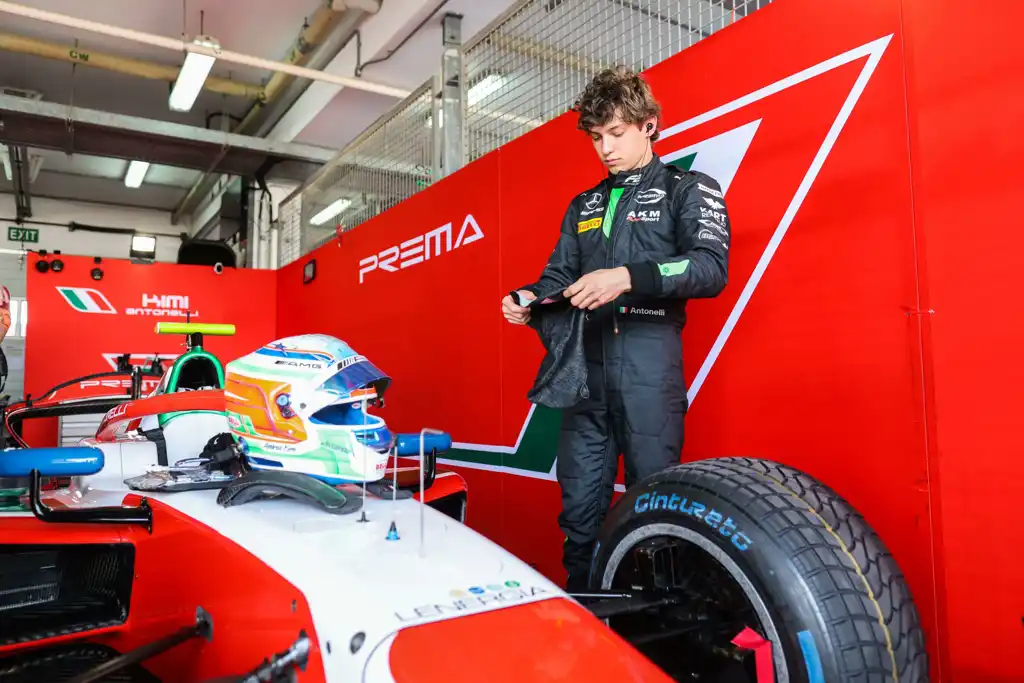
Mercedes did not need to run every racing team in which Antonelli competed. He raced for Prema in Formula 4, Formula Regional and Formula 2. The important consideration was finding the appropriate championship and team for his development at each stage.
This is a reminder that progression should be based on what a driver needs to learn, rather than simply moving up the ladder as quickly as possible.
The lesson for drivers: Choose championships and teams based on their ability to advance your development and career objectives. The most expensive or prestigious series isn’t necessarily the best next step.
Before committing to a move, consider whether the competition, equipment, coaching, team environment and financial requirements make sense for your current stage of development.
Getting guidance on this aspect of your career development is important and it is covered in two podcast episodes: Why You Need a Professional On Your Side with Franco Chiocchetti and The Importance of Trust Featuring Harold Miltner.
6. Learn to work with engineers and understand your race car
Wolff specifically highlights the technical education Mercedes provided Antonelli.
The engineering team introduced him to the complexities of a Formula 1 car, including vehicle dynamics, aerodynamics and driver-in-the-loop simulation.
His race engineers then helped him develop the ability to communicate technical feedback, work on car setup, manage tyres and understand race execution.
This is particularly important because Wolff describes technical understanding as one of the qualities that separates genuinely exceptional drivers from those who are simply fast.
A driver needs to understand what the car is doing, communicate what they are feeling and work with engineers to find solutions.
The lesson for drivers: Become a student of your race car. Learn the technical fundamentals, understand setup changes and develop the vocabulary to communicate effectively with engineers and mechanics.
Don’t just tell your engineer that the car is understeering or oversteering. Learn to explain when it happens, where it happens, under what conditions and how it affects your performance.
The better your feedback, the more effectively your team can help you improve. Michelle Della Penna makes this point quite eloquently in the podcast episode Why You Need to Know Your Car with Michelle Della Penna.
7. Learn to manage pressure, setbacks and expectations
Perhaps the most revealing part of Antonelli’s development was his difficult introduction to Formula 1.
Mercedes knew that promoting an 18-year-old driver directly into a top team would bring enormous pressure. He was replacing Lewis Hamilton, one of the most successful drivers in the sport’s history, and would be under intense scrutiny.
There were difficult weekends, mistakes and periods when results did not come.
Wolff says Mercedes expected these setbacks. The organization understood that development takes time and that it would be unreasonable to expect a young driver to learn while simultaneously punishing him for making mistakes.
In Our Success, Wolff makes a particularly important observation: the measure of Kimi’s potential was never where he stood after one difficult race, but where he could be in the years ahead.
Mercedes remained committed to its decision despite criticism.
The lesson for drivers: Don’t allow individual results to define your assessment of your career. Mistakes and disappointing performances are inevitable. What matters is whether you understand what went wrong, learn from it and make measurable progress.
Develop the ability to:
- Accept criticism without becoming defensive.
- Analyze mistakes objectively.
- Separate one bad performance from your overall ability.
- Manage expectations and outside pressure.
- Maintain confidence while recognizing areas that need improvement.
Resilience isn’t simply about bouncing back. It is about using difficult experiences to become a better driver.
In Training Your Brain & Body to Perform Under Stress with Jim Leo, Jim explains the importance of training your brain and your body to perform under stress and is well worth a listen. You also should have a listen to The Importance of Mental Performance Coaching Featuring Caroli Remmlinger for more advice on this important topic.
8. Develop the personal qualities that make people want to work with you
This is one of the most important themes in Wolff’s assessment of Antonelli.
He repeatedly emphasizes Kimi’s humility, integrity, loyalty, determination and willingness to listen.
His point is that raw talent can open doors, but personal character helps determine whether people will continue investing in you.
A racing career involves working with mechanics, engineers, team owners, sponsors, managers, media and fellow competitors. Your ability to build and maintain those relationships matters.
Wolff also highlights how Mercedes helped Kimi prepare for the responsibilities that come with being a professional driver, including dealing with media attention, expectations and pressure.
The lesson for drivers: Your reputation is part of your professional value. Be respectful, dependable, approachable and willing to learn. Treat everyone in the paddock professionally, regardless of their position or influence.
Don’t underestimate the importance of being someone that teams, sponsors and other motorsport professionals actually want to work with.
In Why Authenticity is Key with Silvia Schweiger, Silvia delves deeper into this topic on the Motorsport Prospects Podcast and it is well worth a listen.
9. Have a long-term development plan, not simply a racing budget
The LinkedIn analysis offers an especially useful perspective on how Mercedes structured its investment.
Its five-stage model connects talent identification, selection, development, competitive opportunities and integration into the senior organization.
In other words, the objective wasn’t simply to fund a young driver through a series of championships. It was to prepare that driver for a specific professional opportunity.
This is an important distinction for drivers planning their own careers.
Moving from karting to Formula 4, Formula 3, Formula 2 and eventually Formula 1 is not a career plan in itself. Each step needs to serve a purpose.
The lesson for drivers: Build a development plan that connects your current position to your ultimate career objective.
For each season, identify:
- The driving skills you need to improve.
- The competitive experience you need to acquire.
- The people and professional resources you need.
- The financial resources required.
- The results and milestones that will demonstrate progress.
- The opportunities you want to create for the following season.
This also gives potential sponsors and supporters a much clearer understanding of what they are investing in.
The importance of long-term planning is covered in two podcast episodes. Dan Wells talks about the importance of long-term thinking in the podcast episode The Importance of Long-Term Thinking with Dan Wells. Simon Hayes emphasizes this as well in The Importance of Long-Term Planning with Simon Hayes as does Mick Gomme in Why You Need to Have a Plan with Mick Gomme.
10. Take responsibility for your own development
Despite all the resources and people involved, Wolff is very clear about one thing: nobody else can do the driving for Kimi.
His letter concludes by recognizing that determination, resilience, courage and the willingness to keep learning have to come from the driver himself.
Mercedes could provide the opportunity, coaching, equipment, financial backing and technical expertise. But Kimi had to make the most of those resources.
Wolff specifically praises his willingness to listen, learn from mistakes and continue believing in what he could achieve.
The lesson for drivers: Don’t expect a team, sponsor, manager or coach to take responsibility for your career. They can provide guidance and opportunities, but you must own your development.
Be proactive. Seek feedback. Identify your weaknesses. Follow through on commitments. Take responsibility when things go wrong and make the most of the opportunities you receive.
Ultimately, the people supporting you can help create a successful driver, but they cannot create your determination. As Mac Clark explains, you should be Treating Your Career as a Start-Up Featuring Mac Clark. You also need to be the whole package as explained in Why Drivers Need to Be the Whole Package Featuring Robert Burgess of Radical Canada.
The bigger picture: What self-funded race drivers should take away
There are three overarching lessons from Mercedes’ approach that I think deserve particular attention.
1. Talent needs to be developed, not just discovered.
Being naturally fast is important, but it is only the foundation. A successful driver needs a combination of driving ability, technical knowledge, physical and mental preparation, professional skills and personal character.
2. A racing career is a business that requires a team.
Even though motorsport is an individual sport from the driver’s seat, building a professional racing career is a collective undertaking. You need the right people, resources, relationships and opportunities working together.
3. Think long-term rather than focusing exclusively on the next race.
Mercedes invested in Antonelli over approximately seven years, reportedly committing more than €10 million to his development. It had a plan, the resources to execute it and the patience to allow that plan to work.
Most independent drivers won’t have access to that level of investment. But they can adopt the same strategic thinking: identify what they need, build the right support network, invest intelligently in their development and establish measurable career objectives.
There is one final point from Wolff’s letter that I think every aspiring professional driver should consider:
Believing in someone is much easier when so many good people have already given you every reason to believe.
That is a powerful reminder that building a racing career is about earning the confidence of others through your ability, attitude, preparation and professionalism.
And just as importantly, becoming a driver that people believe in starts with giving them good reasons to do so.
Source material and further reading
The three sources offer complementary perspectives:
1. Toto Wolff on spotting F1 talent and why prodigies wash out – Explores the qualities Mercedes looks for when identifying promising drivers, including natural ability, technical aptitude, intelligence and character. Read the article here.
2. Alessio Santosuosso: €10m+ invested in one young driver – Explains Mercedes’ five-stage talent-development model: Identify, Select, Develop, Deploy and Integrate. Read his LinkedIn post here.
3. Toto Wolff: Our Success – His personal account of the many people and organizational contributions behind Antonelli’s development, and why the achievement belongs to all of them. You can read the text of his letter here.

Author: Mark Boudreau
Mark is the publisher of Motorsport Prospects and the host of the Motorsport Prospects Podcast. As a lawyer, he applies his legal background and research skills to assist race drivers by showcasing the resources they need to make their motorsport careers happen.
